
Cushings Disease
Cushing’s Disease in dogs
Overview
- Cushing’s disease is a condition caused by abnormally high levels of the hormone cortisol in the body, which is normally produced in exact amounts by the adrenal glands.
- It causes a wide range of symptoms, including excessive drinking and weeing, bald patches, excessive appetite, and a pot-belly.
- Treatment for Cushing’s involves daily lifelong medication to reduce cortisol production.
- With treatment, the outlook for a dog with Cushing’s is good.
- Although Cushing’s can affect any dog, it’s more common in middle-aged, small breeds such as Boston Terriers.
What is Cushing’s Disease?
Cushing’s disease (also known as hyperadrenocorticism) is a condition that develops in the body due to high levels of the hormone cortisol. Cortisol is an essential hormone normally produced by the adrenal glands and the amount produced is closely controlled by signals from the pituitary gland in the brain. Cushing’s disease develops when the adrenal gland becomes overactive and releases too much cortisol. This can be due to:
- A tiny brain tumour in the pituitary gland– that sends too many signals to the adrenal glands, telling them to produce more cortisol. This is the most common cause of Cushing’s. A brain tumour sounds scary but it’s usually a small, benign tumour that causes no problems other than Cushing’s.. It will usually be seen in middle to older age dogs.
- An adrenal gland tumour– that causes the adrenal gland to become overactive and produce more cortisol than normal.
A similar condition, called Cushing’s syndrome can be caused by:
- High dose steroid medication- occasionally, Cushing’s is brought on by long-term, high dose steroid This is called iatrogenic Cushing’s. If you are concerned that your dog is showing any symptoms of Cushing’s, you should never change the dose of medication your dog is on without discussing it with your vet first
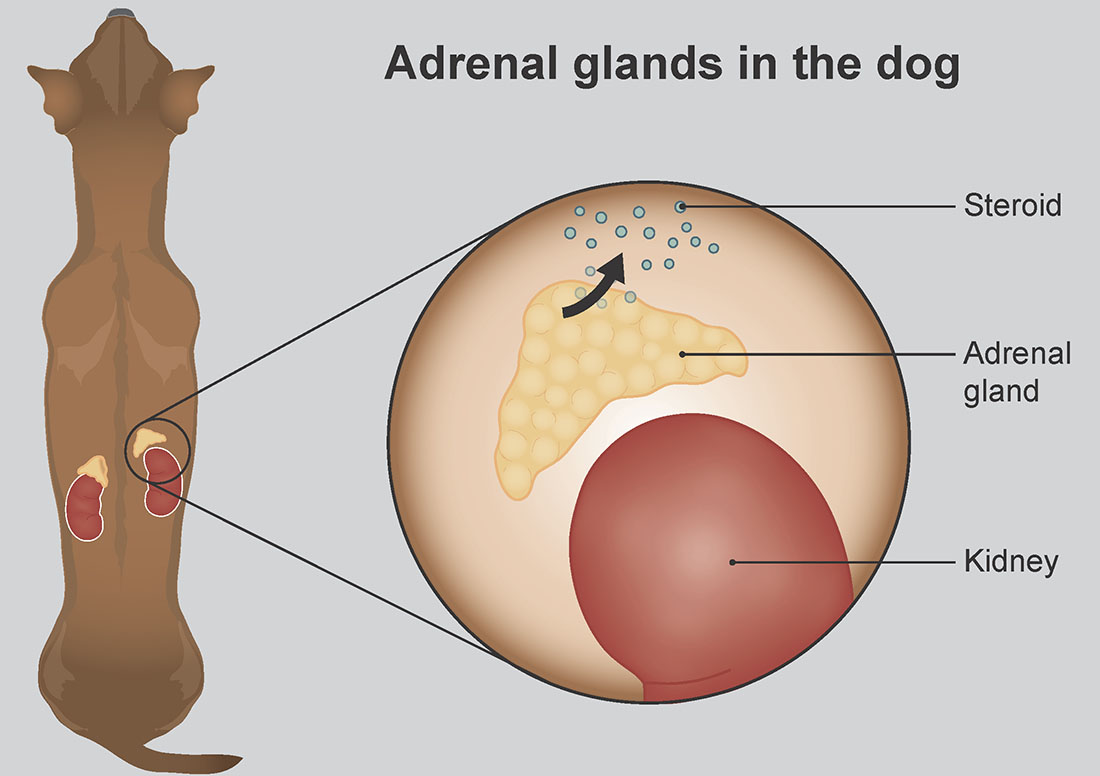
The adrenal glands usually produce steroid. Click image to enlarge.
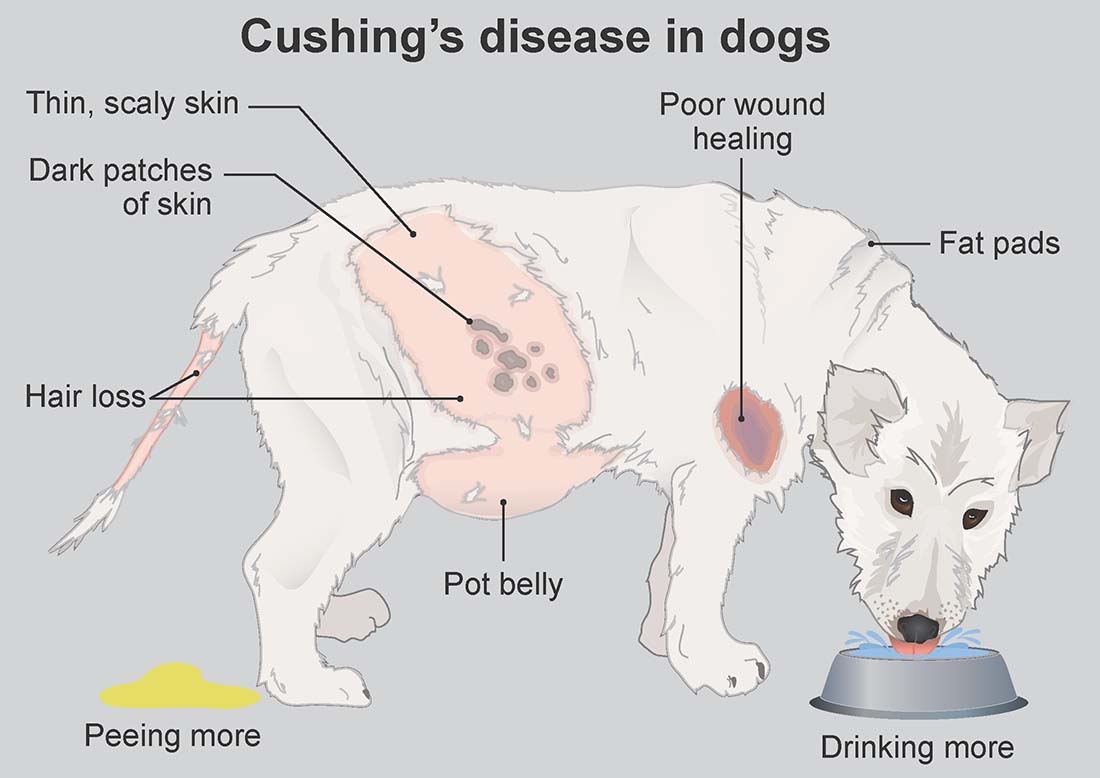
Symptoms of Cushing's include a pot belly.
Symptoms
Common symptoms of Cushing’s include:
- Excessive drinking and peeing
- A ‘pot-belly’ (swollen stomach)
- Bald patches especially on the sides/flanks and tail
- Excessive hunger
- Dark patches on skin
- Thin, scaly skin prone to blackheads and infections
- Wounds that are slow to heal
- Low energy
- Panting more than usual
- Muscle loss/wastage
When to contact your vet
Contact your vet if you think your dog has symptoms of Cushing’s, even if they seem otherwise well. It will help your vet if you take a urine sample and a note of how much your dog drinks in a 24-hour period. Watch our videos below for guidance on how to collect a urine sample and measure how much your dog is drinking.
You know your dog best, always contact your vet if you’re concerned
Dogs with Cushing’s disease often develop a unique appearance, so your vet may suspect the condition simply by looking at your dog. However, further tests are needed as there are other illnesses that can show similar signs and it is important to confirm the diagnosis before starting your dog on lifelong medications.
Tests may include blood tests (they will usually need more than one blood test), urine tests and an ultrasound scan. Advanced imaging such as a CT (computerised tomography) may also be advised by your vet. Sometimes, it can be tricky to diagnose Cushing’s and your vet may suggest repeating some tests over a period of time before getting a diagnosis.
Treatment
Medication – most cases of Cushing’s can be treated with medication that controls cortisol production. The medication needs to be given to your dog for the rest of their life. It’s important to give the correct dose because if too much is given, cortisol levels may drop dangerously low and cause Addisons disease (hypoadrenocorticism). Contact your vet immediately if you suspect your dog has had an overdose of their medication.
Surgery – specialist vets may operate to remove the tumour in the adrenal gland or brain but it’s important to be aware that these surgeries have risks and are expensive. Talk to your vet about whether these surgeries may be suitable for your dog.
For iatrogenic Cushing’s – depending on why your dog is on steroids, it may be possible to wean the steroid dose down gradually with the aim of eventually stopping steroid treatment. This is always done gradually, as stopping steroids suddenly can cause serious health issues for your dog. Always speak to your vet before changing any dose of medication.
Ongoing care
Regular vet checks will be necessary to monitor your dog’s progress, particularly in the first few months after diagnosis. Blood tests are often necessary to check your dog’s cortisol levels to ensure they are on the right amount of medication.
Monitoring at home. Monitor your dog and keep a note of any new or changing symptoms.
Drinking and peeing. Never restrict your dog’s access to water and make sure they always have somewhere to pee. It can take a few weeks for symptoms to improve and they may always drink and pee a little more than they used to. It’ll help your vet if you keep a water diary i.e. every 1-2 weeks, make a note of how much your dog drinks in a 24-hour period.
Outlook
With treatment. If your dog responds well to treatment, some symptoms are likely to start improving within a few weeks (other symptoms take a few months to improve) and their outlook is very good. Many dogs with well-controlled Cushing’s can live a relatively normal and happy life for many years.
Without treatment. Some dogs with Cushing’s disease live without treatment for some time, but tend to be happier and healthier with a better quality of life on medication. Left untreated, they are more prone to contracting infections, they will become more lethargic over time and all of their symptoms will gradually worsen.
Source : PDSA